
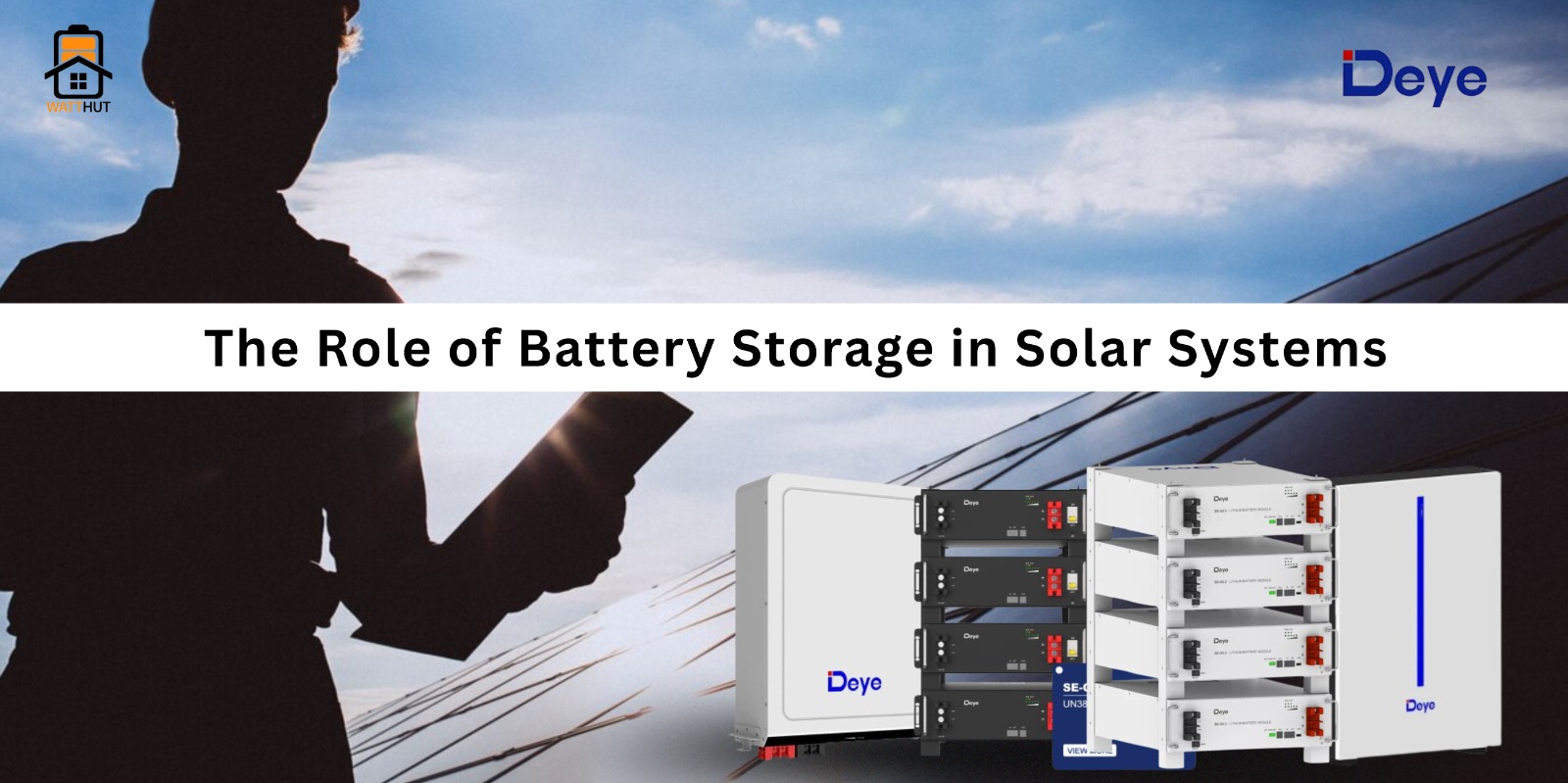
The Role of Battery Storage in Solar Systems
As solar adoption accelerates across residential, commercial, and industrial sectors, battery storage has moved from a ‘nice-to-have’ to a critical component in solar energy systems. At Watthut, where we specialise in energy storage integration and inverter-battery compatibility, we believe it’s vital to understand why battery storage is no longer optional — but essential for modern solar systems.
In this article, we explore the function, importance, and strategic value of battery storage in solar installations.
What Is Battery Storage in Solar Systems?
Battery storage systems store surplus electricity generated by solar panels, which can be used later when sunlight is unavailable — such as during evenings, cloudy conditions, or power outages. In simple terms, batteries bridge the gap between production and consumption, ensuring energy availability whenever it’s needed most.
Why Is Battery Storage Important?
While solar panels generate clean energy, they do so only when the sun is shining. Without storage, any unused energy is either wasted or exported to the grid (in grid-connected setups). Battery storage systems allow users to:
- Maximise solar self-consumption
- Ensure energy availability during blackouts
- Reduce peak-time energy dependency
- Enhance energy independence
Let’s break it down further.
1. Improved Energy Independence
With battery storage, consumers rely less on utility providers. In areas where electricity prices are volatile or grid infrastructure is unreliable, having a well-sized battery system allows consistent power supply even when the grid fails.
This is especially important for:
- Remote areas with no or poor grid connectivity
- Critical commercial operations (hospitals, data centres, etc.)
- Industrial clients with heavy-load equipment sensitive to outages
2. Load Shifting & Time-of-Use Optimisation
Many energy providers have Time-of-Use (ToU) billing structures where electricity is cheaper during off-peak hours. A battery allows users to store solar energy during the day and use it during high-tariff periods — reducing energy costs significantly.
This strategic load shifting helps in:
- Reducing grid dependency during peak demand
- Lowering operational costs for commercial and industrial users
- Flattening demand curves in smart grid environments
3. Backup During Power Outages
Grid failures — whether due to natural calamities, infrastructure overload, or maintenance — can disrupt daily life and operations. Batteries ensure uninterrupted power supply by instantly switching to stored energy during outages.
Unlike on-grid-only systems that shut down during blackouts (due to anti-islanding), solar + storage systems continue supplying energy, maintaining uptime for essential loads.
4. Maximising Solar Self-Consumption
In net-metered systems, unused solar energy is exported to the grid for credit. But in many regions, feed-in tariffs are decreasing or eliminated. Storing surplus energy for personal use is now more financially beneficial than exporting it.
Batteries enable:
- Higher solar utilisation
- Faster return on investment (ROI)
- Reduction in energy exported at lower rates
5. Supporting Grid Stability
At a macro level, battery storage integrated into distributed solar systems plays a role in grid balancing. As more solar capacity feeds into the grid, energy storage helps manage the intermittency of renewable energy, ensuring smooth supply during peak demand or low-generation periods.
How to Size a Battery for a Solar System?
Battery sizing depends on several key parameters:
- Load Demand – The daily energy consumption (in kWh) of the property
- Autonomy Requirement – Number of backup hours or days needed
- Depth of Discharge (DoD) – The usable capacity of the battery
- Solar Generation Profile – How much excess energy is typically available for storage
- Inverter Compatibility – Ensuring that the inverter supports the battery’s voltage and current range
A 5kW hybrid solar system with 20kWh daily load may require a 10–15kWh battery for partial backup and peak shifting.
Exact sizing must be based on site-specific data.
On-Grid vs Off-Grid vs Hybrid: Where Do Batteries Fit?
| System Type | Battery Usage | Purpose |
|---|---|---|
| On-Grid (with no battery) | Optional | Feed excess power to grid; no backup |
| On-Grid (with battery) | Optional | Backup + ToU optimisation |
| Off-Grid | Mandatory | Power supply & storage |
| Hybrid | Recommended | Smart switching, savings + backup |
Economic and Regulatory Considerations
The economics of battery storage is improving rapidly due to:
- Falling lithium-ion battery costs
- Government subsidies/incentives in some regions
- Rising electricity tariffs and ToU billing
- Decreasing net metering benefits
The Watthut Advantage
- Accurate system sizing based on load profile and backup needs
- Inverter-battery compatibility consultation
- Lithium-ion battery recommendations (LiFePO4 preferred)
- Technical assistance during deployment
- Scalable solutions for future upgrades (EV, automation, etc.)
Final Thoughts
If you’re planning to integrate battery storage into your solar solution or want expert guidance on selecting the right configuration, connect with the Watthut team for a customised consultation.
Vist watthut.com or contact our experts to make your solar investment smarter, stronger, and future-ready.