
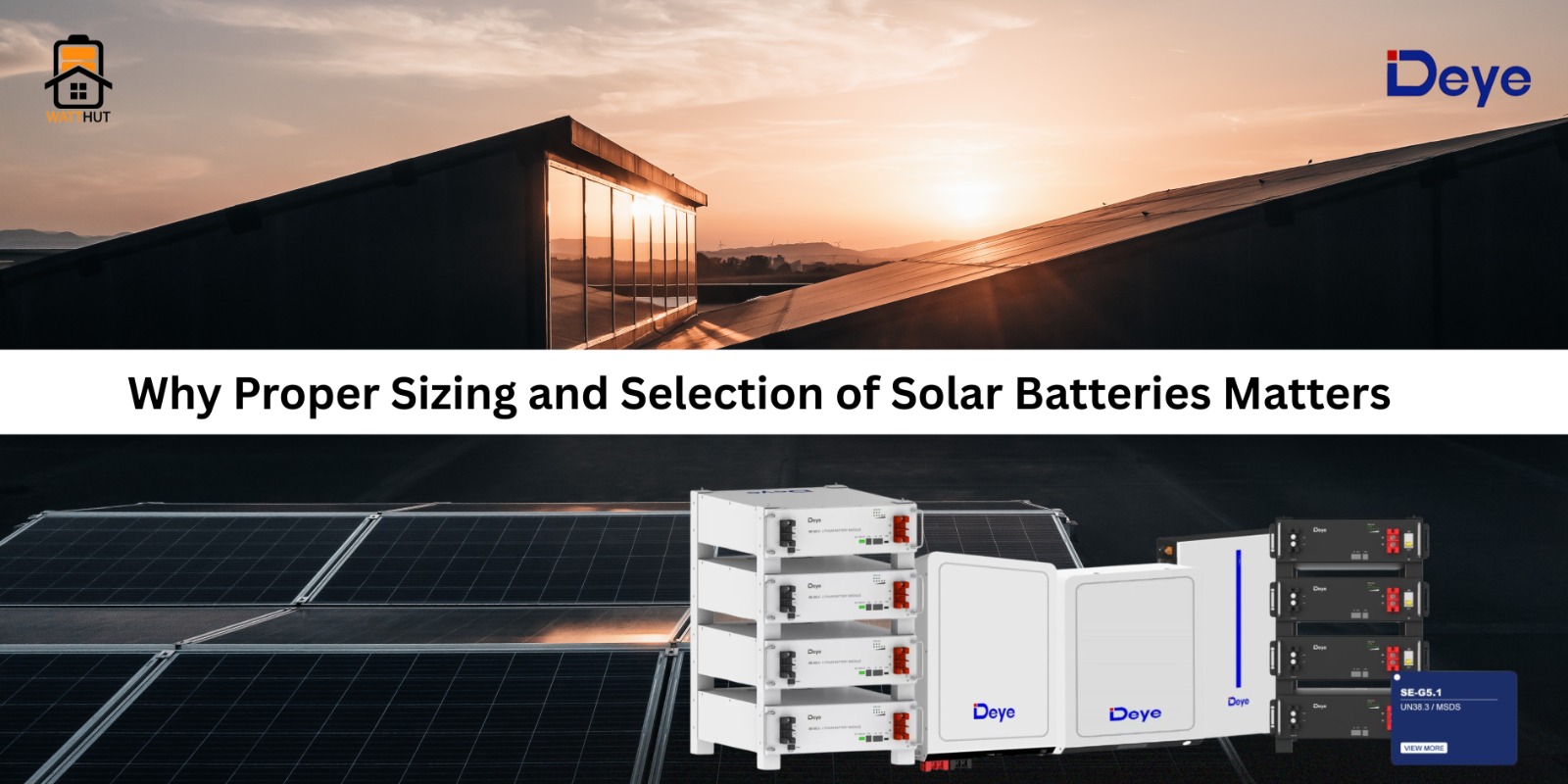
Why Proper Sizing and Selection of Solar Batteries Matters
In solar energy systems, the battery is not just a storage component—it’s the heartbeat of performance reliability and energy independence. Whether you’re designing an off-grid system, hybrid solution, or peak-load backup, the success of the system heavily relies on proper battery sizing and selection.
At Watthut, we work closely with EPCs, commercial clients, and solar integrators to deliver accurately sized battery solutions based on application, load profile, and usage behaviour. In this blog, we’ll walk you through why correct sizing matters, the technical principles behind it, and how the right battery can transform your solar investment.
1. What Does Battery Sizing Mean?
Battery sizing refers to determining the optimal capacity (kWh) and voltage of a battery system based on:
- Daily energy consumption
- Backup time requirements
- Solar generation availability
- Depth of Discharge (DoD) and inverter compatibility.
Without proper sizing, the battery may drain too fast, remain under-utilised, or fail prematurely —resulting in poor performance and high operational costs.
2. Consequences of Incorrect Sizing
Improper battery sizing can lead to:
- Underperformance: Inadequate capacity leads to short backup times.
- Overinvestment: Oversized batteries increase project cost without added value.
- Low ROI: Batteries not matched to inverter or load won’t deliver full potential.
- Premature degradation: : Frequent over-discharge or partial charging reduces lifespan.
At Watthut, we ensure sizing is neither excessive nor insufficient, but precisely matched to the site’s needs.
3. Key Parameters for Battery Sizing
To determine the correct battery configuration, several variables must be analysed:
| Parameter | Explanation |
|---|---|
| Load Profile | Daily and peak power demand in kWh |
| Autonomy Requirement | Number of hours or days the battery should provide backup |
| Battery Type | LiFePO4, Lead-acid, or other chemistries have different usable capacity |
| Depth of Discharge (DoD) | % of the battery’s total capacity that can be safely used |
| Charging Source | Whether charging is only solar-based or includes grid/genset |
| Inverter Compatibility | Voltage/current input range must align with battery specs |
4. Understanding Depth of Discharge (DoD)
Each battery type has a safe usage limit, known as DoD. For example:
- Lead-acid batteries: Recommended DoD = 50%
- LiFePO4 batteries: Recommended DoD = 80–90%
This means a 10kWh lead-acid battery provides only ~5kWh usable energy, while a 10kWh LiFePO4 battery gives up to 9kWh.
Thus, battery chemistry significantly affects the usable capacity and must be factored into sizing calculations.
5. Calculating Battery Capacity (Simplified)
Formula:
Battery Capacity (kWh) = (Daily Load × Backup Hours) / (DoD × Efficiency)
Example:
- Daily Load = 10 kWh
- Backup Hours = 8
- DoD = 0.8 (for LiFePO4)
- Battery Efficiency = 0.95
➡️ Required Battery = (10 × 8) / (0.8 × 0.95) = 105 kWh (rounded)
Note: For actual project use, Watthut applies advanced tools and considers seasonal variation, system losses, and solar panel availability.
6. Battery Selection Based on Application
Every application has different needs. Here’s how battery selection varies:
| Application | Recommended Battery | Reason |
|---|---|---|
| Residential Backup | LiFePO4 (5–15kWh) | Long cycle life, compact, safe indoors |
| Commercial Solar with ToU | Modular lithium banks (10–50kWh) | Load shifting, grid export control |
| Off-grid Systems | Scalable LiFePO4 or Industrial Lead-acid | Full autonomy, higher discharge |
| Industrial Applications | High-voltage Lithium or Flow batteries | Peak shaving, large loads |
7. Lithium-ion vs Lead-acid: Which Is Right for You?
| Feature | Lead-Acid | Lithium-ion (LiFePO4) |
|---|---|---|
| DoD | ~50% | 80–90% |
| Lifespan | 1000–1500 cycles | 3000–6000 cycles |
| Maintenance | Regular | Zero |
| Footprint | Large | Compact |
| Cost (initial) | Lower | Higher |
| Cost (lifetime) | Higher | Lower |
| Safety | Lower (gas/leak risk) | Higher (BMS protected) |
At Watthut, we typically recommend LiFePO4 batteries for most modern solar systems due to their efficiency, safety, and longevity—unless a specific application justifies otherwise.
8. Importance of Battery-Inverter Compatibility
A common mistake in battery-based solar projects is overlooking compatibility between inverter and battery. Important checks include:
- Voltage matching : 48V, 96V, 120V etc.
- Charging parameters: Current/Voltage range
- Communication protocols: for lithium systems with BMS
- Discharge limits: Prevent overdraw that can damage both components
Watthut offers pre-integrated inverter-battery pairings or helps EPCs configure these combinations to ensure smooth performance.
9. Planning for Scalability
Today’s energy needs are dynamic. Battery sizing should allow for future expansion based on:
- Load growth (e.g., addition of appliances or machines)
- EV charging integration
- More solar panel installation
- Smart automation (IoT-based load shifting)
Our battery solutions are modular and stackable, enabling seamless upgrades without system overhauls.
10. Watthut’s Process for Battery Sizing
At Watthut, battery sizing is not guesswork. Our approach includes:
- ✅ Load audit and consumption profiling
- ✅ Solar generation analysis (irradiation, panel data)
- ✅ Backup needs and usage behaviour
- ✅ Product type consultation: LiFePO4 vs GEL vs VRLA
- ✅ Compatibility with inverters and charge controllers
- ✅ Climate and site condition considerations
- ✅ ROI and lifecycle cost evaluation
We create complete battery system blueprints that EPCs and installers can directly implement.
Final Thoughts
In the world of solar power, a battery is more than an accessory—it’s a strategic asset that defines system autonomy, reliability, and financial return. Proper sizing and selection ensure that your battery doesn’t just work, but works efficiently, safely, and economically.
Whether you're building a residential backup system or a multi-site commercial energy solution, Watthut ensures that your battery is:
- Right-sized
- Right-selected
- Fully integrated
- Future-ready
Let’s Power It Right from the Start.
Connect with Watthut’s technical team today for a custom battery sizing solution that supports your project’s energy goals without compromise.
Visit: watthut.com